course-c
Introduction
:::: {.columns}
::: {.column width=”40%”}
-
Pointers are variables that store memory addresses
-
They store the address of a memory region that stores a particular type of data
-
The size of a pointer is determined by the address size of the CPU
int* p;
int i = 10;
p = &i;
:::
::: {.column width=”60%”}

:::
::::
Pointer declaration
-
A pointer is declared using the
*operatorint* p; -
*is called the dereferencing operator because*preturns the value of the valueppoints to -
The
&operator is used to recover the memory address of a variable; it cannot be applied to expressions, constants, or register variablesp = &i;
Pointer assignment and usage
-
Pointers of the same type can be assigned to one another
int i = 10; int* ip = &i; int* iq = ip; // iq now points to i -
Operator precedence in usage of
*operator*ip += 1; ++*ip; (*ip)++;-
increment value pointed to by
ip -
*ip++;would be incorrect; why?
-
Function arguments
-
Arguments are passed to a function by value, even pointer arguments
-
Pointers provide a mechanism for functions to alter the value of referenced variables
-
Exercise: write a function that swaps the value of its arguments
Arrays
:::: {.columns}
::: {.column width=”40%”}
-
Arrays provide contiguous storage to multiple elements of the same type
int a[10]; -
Elements of arrays declared as
extern,staticandautoare initialized to zero -
The array index starts at zero
:::
::: {.column width=”60%”}

:::
::::
Array initialization
-
Arrays can be initialized during declaration
int days[] = {5, 10, 15, 25, 30};- compiler fills in the size and fills the array
char name[] = "name";- right-hand side is a string constant
char name[] = {'n', 'a', 'm', 'e'}; -
Arrays can be initialized using assignment statements or using loops
int days[5];
days[0] = 5;
Pointers vs Arrays
:::: {.columns}
::: {.column width=”60%”}
-
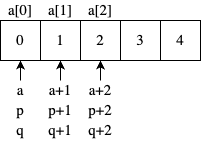
Arrays and pointers are related
int a[5] = {0 , 1, 2, 3, 4}; int* p = &a[0]; int* q = a;aalways points to the start of the array and cannot be changed
:::
::: {.column width=”40%”}
:::
::::
Pointer operations
-
Pointers can be incremented in integer steps
-
p++points to the next element- what does
*p++ = 10do? (hint – see operator precedence table)
- what does
-
p--points to the previous element- what does
*--p = 10do? (hint – see operator precedence table)
- what does
-
p+=ipoints toielements beyond the current position -
p-=ipoints toielements before the current position -
p = 0orp = NULLmakes p a null pointer; a valid pointer that does not point to anything in particular
Strings
-
Strings constants are arrays of
charchar name [] = "name"; -
Since an array of
charcan be assigned to a pointer tochar, a pointer tocharcan refer to a string constantchar* name = "name"; -
strlen(s)can be used to calculate length of a stringstrlen(name) returns 4 -
A string is internally padded with NULL character or
'\0';nameis thus internally 5 characters long -
Exercise: write a function to replace
strcpy
Multi-dimensional arrays
-
Declaration
int a[10][20];- 10 rows and 20 columns, contiguous storage for 200 integers
-
Initialization
int a[][2] = { {1,2}, {3} }; int (b[])[2] = { {1,2}, {3} };- The number of columns (length of each row) needs to be known beforehand; try printing
a[1][1], what do you get?
- The number of columns (length of each row) needs to be known beforehand; try printing
Wasted space with multi-dimensional array
:::: {.columns}
::: {.column width=”60%”}
-
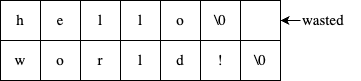
This is how you would construct an array of string constants
char a[][7] = {"hello", "world!"};
printf("%s %s\n", a[0], a[1]);
:::
::: {.column width=”40%”}
:::
::::
Array of pointers instead of multi-dimensional array
:::: {.columns}
::: {.column width=”60%”}
-
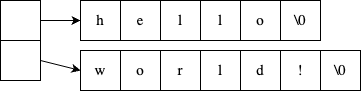
The multi-dimensional array shown earlier may be substituted by an array of pointers to
charchar* a[] = {"hello", "world!"}; printf("%s %s\n", a[0], a[1]);
:::
::: {.column width=”40%”}
:::
::::
Pointers to multi-dimensional array
:::: {.columns}
::: {.column width=”40%”}
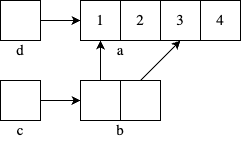
  int a[2][2] =
    { {1,2}, {3,4} };
  int *b[2], **c, *d;
  b[0] = a[0];
  b[1] = a[1];
  c = b;
  d = (int *)a;
:::
::: {.column width=”60%”}
 {width=50%}
:::
::::
Main function
:::: {.columns}
::: {.column width=”60%”}
-
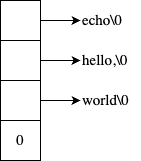
mainfunction syntaxmain (int argc, char * argv[])
:::
::: {.column width=”40%”}
 :::
::::
Command line arguments
argcis the number of arguments in the command-line that invoked the program- always at least
1because the program name is itself an argument
- always at least
-
argvis an array of pointers tochar, each element points to a string argv[argc]required to be aNULLpointer
Pointers to Functions
-
Pointers can point to functions
-
Functions are very different from variables, but have an address where they start
-
Declare a pointer to a function
int (*p)(int* a, int* b) -
Assign a function
p = add; -
Call the function
int a = b = 2;
(*p)(&a, &b);
void pointer
-
Any pointer type can be assigned to, or passed to a function as, a void pointer
int* ip; void* vp = ip; -
void pointer can be cast to any pointer type
char* cp = (char*) vp; -
Useful for making generic functions that apply to various types
-
Be careful when casting
void*to another type; know what you are doing
Dynamic memory allocation
-
Pointers not yet initialized are dangerous if they are not NULL pointers
-
Pointers can be initialized to point to storage dynamically allocated using
mallocorcalloc -
freemust be used to release the allocated memory
malloc
-
Allocates
nbytes of storage and returns a void pointer to itvoid* malloc(size_t n) -
Example
int* ip = (int*)malloc(10 * sizeof(int)); free(ip);sizeofoperator returns the size of the object or type specified
calloc
-
Allocates memory for
nobjects of sizesizeand returns a void pointer to itvoid* calloc(size_t n, size_t size) -
The memory assigned is initialized to zeros
-
Example
int* ip = (int*)calloc(10, sizeof(int));
free(ip);
Memory allocation problems
-
Using an uninitialized pointer
-
Writing to memory outside the allocated region (buffer overflow)
-
Freeing memory not allocated using malloc or calloc
-
Not freeing memory allocated using malloc and calloc (memory leak)
Using memwatch
-
memwatch is distributed as a single source file
memwatch.cand its accompanying header filememwatch.h -
Source files you want to watch for memory problems must include
memwatch.hand be recompiled using the following compiler options-DMEMWATCH -DMW_STDIO -
memwatch prints an error message in the standard output and produces a detailed log file listing the memory problems it encounters
Exercise
- Write a program that sorts an array of strings. Use your favorite sorting algorithm (bubble sort, insertion sort, etc). Write your own replacement for
strcmpto compare the strings. Write a generic sort function that can work with arrays of other types